
About Phoenix College
The challenge
Many students at Phoenix College arrive facing a significant jump in the kinds of academic writing they’ve completed before and the expectations in their college courses. For multilingual learners, working adults, or those balancing school with other responsibilities, writing assignments can be challenging to manage and can become obstacles to course completion and continued progress.
Instructors also felt the strain. Time spent correcting mechanical writing issues left less room for deeper feedback on content, structure, and discipline-specific thinking. Phoenix College saw a need for writing support that could scale, one that would not require changes in student writing workflows that create extra burden for students or faculty, but that would help students strengthen their writing before submitting their work.
The intervention: Always-on writing support at scale
Phoenix College partnered with Grammarly for Education to make writing support available to all enrolled students and instructors across the campus. Key features of the rollout:
- All students and faculty received access to Grammarly for in-line support in the writing surfaces they already used, such as word processors, browser-based documents, and learning management systems.
- Participation was flexible. The College offered resources and onboarding for instructors who wanted support, while others shared successful practices with colleagues, which helped adoption grow organically across departments.
- No additional platforms or complicated workflows were required. Writing support met students where they already wrote.
What changed: Measurable gains in completion, retention, and GPA
*The findings presented here come from a study conducted by LXD Research, an independent third-party research firm specializing in evaluating educational effectiveness. LXD Research partnered with Phoenix College to analyze Grammarly usage data and student outcomes. All analyses were conducted independently to ensure methodological rigor.
The study compared 569 Grammarly users with 3,067 non-users enrolled in writing-intensive courses during the 2023–2024 academic year. Outcomes measured included course completion, retention, GPA, usage behavior, and success across modalities and student subgroups.
See Phoenix College’s results:
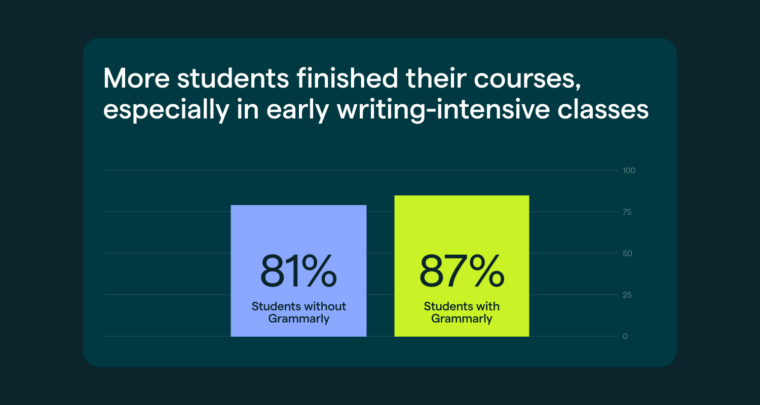
More students finished their courses, especially in early writing-intensive classes
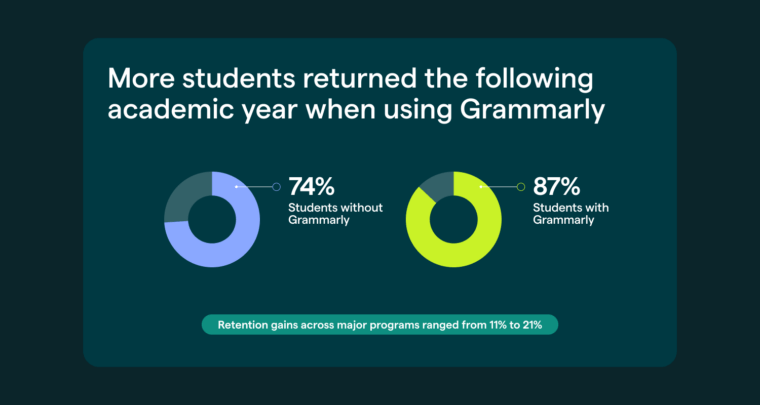
More students returned the following academic year
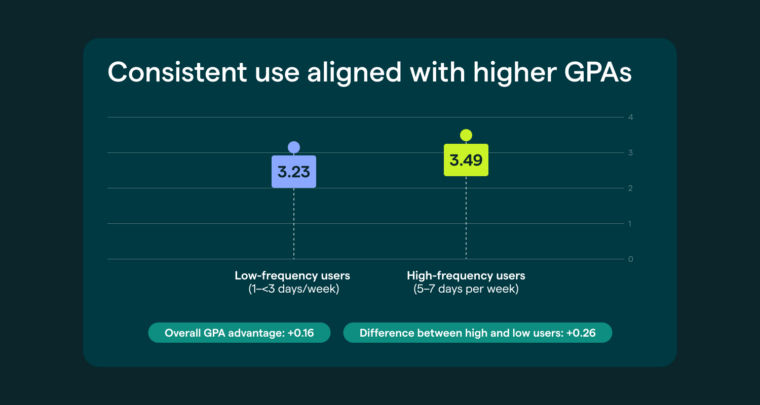
Consistent use aligned with higher GPAs
Completion gains appeared across online, hybrid, and in-person learning
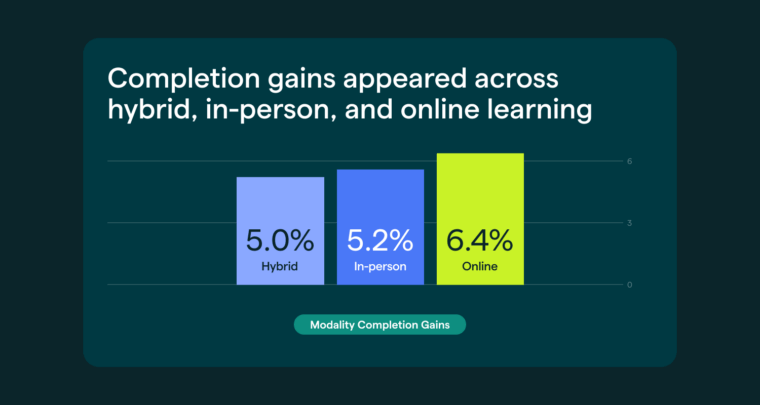
Course completion gains remained steady regardless of how students attended classes. Online learners saw a 6.4 percent lift in completion, hybrid learners a 5.0 percent lift, and in-person learners a 5.2 percent lift. These results reflect Phoenix College’s mix of working adults, transfer students, and first-generation learners, and highlight how always-available writing support helps students succeed across learning environments.
This data suggests that regular use, rather than occasional exposure, combined with broad access, contributed to sustained academic benefits.
What faculty observed: Time for depth, not just mechanics
Grammarly adoption resulted in:
- More tailored feedback provided at scale. Students at different writing levels, including those for whom English is a second language, received early support. Instructors could then focus on higher-order writing skills.
- Time savings for instructors, allowing more focus on meaningful critique and content guidance rather than mechanical edits.
- A focus on writing as a process, where drafting, revising, and refining with support help students grow over time, not just produce a final submission.
Why this matters for Phoenix College
With this approach, Phoenix College:
- Made writing support accessible for working, transfer, and nontraditional students who may write under time or resource constraints.
- Helped instructors focus on higher-order feedback rather than mechanical corrections.
- Improved student outcomes: higher course completion, retention, and GPA. These improvements increase the likelihood that students stay on track toward degree completion.
- Created a model that can be replicated at other institutions, especially community colleges serving diverse student populations.
How Phoenix College made it work
A campuswide approach that focused on access, flexibility, and purposeful design helped writing support take root and deliver measurable gains.
- Lead with access and ease. Every enrolled student and instructor received the same level of support in the writing tools they already used. No new platforms or workflows reduced friction for busy, working, or first-generation learners.
- Support instructor choice. Faculty could integrate Grammarly where it best fit their instructional practice. Many redesigned assignments to include reflection, revision steps, and writing reports, which helped students engage with the writing process more intentionally.
- Encourage purposeful adoption. Workshops, simple onboarding resources, and peer-to-peer sharing helped instructors see how the tool could strengthen feedback and free up time for deeper instruction. Word of mouth across departments grew organic adoption.
- Track momentum indicators. Phoenix College monitored completion, retention, GPA trends, and usage patterns across online, hybrid, and in-person courses to understand where support had the greatest impact.
Phoenix College’s experience points to a consistent pattern. When writing support is accessible to all students, integrated into the learning environments where they already study, and paired with instructor autonomy, more students stay on track and more faculty are able to focus on higher-order feedback. With the foundation in place, Phoenix College plans to continue refining how writing support is embedded across courses, especially in early-momentum and discipline-specific settings.
See the Phoenix College research brief for a snapshot of the study, or review the technical report for a deeper analysis.