

When Dr. Brian Harfe first noticed that AI tools could answer his essay prompts better than most of his students, he did not panic. He redesigned the assignment.
That decision, made in a large-enrollment course at the University of Florida, has since become the subject of a peer-reviewed study published in TechTrends in 2026. What started as one professor’s practical response to a fast-moving problem is now a data-backed framework for how institutions can approach AI in student writing.
The problem with how we have been measuring AI use
Most institutions trying to get a handle on student AI use have landed on two approaches: surveys and AI detectors. Both fall short in predictable ways.
Self-reported survey data is shaped by what students think their instructors want to hear. Students who see AI use as acceptable tend to over-report it; those who fear academic penalties tend to under-report it. Even honest responses run into a memory problem. Few students can accurately reconstruct how much of a final draft came from a chatbot versus their own editing across multiple writing sessions.
AI detectors have a different problem. They work probabilistically, assessing whether text is likely to be AI-generated rather than confirming whether it actually is. None currently achieve 100% accuracy, and most do not tell you how much of a document is AI-generated or which parts. Just a verdict on the whole, which treats writing as a product rather than a process.
Institutions are left with plenty of anxiety about student AI use and very little reliable data about what students are actually doing.
A different approach to the assignment itself
Dr. Harfe’s response was not to add surveillance. It was to change what the assignment asked students to do.
In his University of Florida course titled “Can We Design Better Humans? Should We?”, he redesigned the final essay around AI rather than removing it. Students were required to begin with a fully AI-generated draft, then revise it to reflect their own views on human cloning and genetic engineering. The final submission had to represent the student’s perspective. How much of the AI draft they kept, changed, or discarded was up to them.
That design did something the traditional essay could not: It removed the incentive to hide AI use. Students were not penalized for leaning on the draft or rewarded for avoiding it. The question shifted from whether they used AI to what they actually did with it.
To track that objectively, Dr. Harfe used Grammarly Authorship, a writing transparency tool that tracks the origin of text. Unlike AI detectors, Authorship does not deal in probability. It records provenance, identifying whether each word was typed by a human, copied from an AI tool, or pulled from another source.
Students submitted their Authorship reports alongside their essays, and Dr. Harfe could use the tool’s replay feature to watch how each submission evolved from AI draft to finished product.
What 310 essays revealed
The resulting dataset, 310 essays from students across seven colleges and more than 100 declared majors, is the foundation of the study, Quantitative Analysis of Generative AI Text Usage and Identification of Factors Influencing Text Choice, that Harfe co-authored with Aaron Thomas of the University of Florida’s Information Technology department. It is among the first studies to track student AI use at the word level across a large, diverse undergraduate cohort.
Three findings stand out.
- Engagement shows up in the data. Students who wrote more of their own text took significantly longer to complete the assignment. The correlation was strong and consistent. Time-on-task tracked closely with how much students actually revised, which suggests that when an assignment is built to require genuine engagement, the data reflects it.
- Discipline influences editing behavior. STEM students produced more human-generated text than non-STEM students, even though both groups were equally likely to agree with the AI draft’s position on the topic. Subject-matter familiarity alone does not explain the gap. It’s an open question that the researchers have flagged for further study.
- Academic standing predicted revision depth. Students who performed above their semester- and major-matched peers revised AI-generated text more extensively. The pattern held across every discipline in the dataset. The tendency to push back on a draft appears to reflect broader academic habits more than discipline-specific knowledge.
On average, students kept about 76% of the AI-generated draft in their final submissions. The roughly 5% who genuinely disagreed with the AI’s position edited far more heavily, which reinforces the assignment’s central logic: Students who have something to say added more of their own writing.
The graph below shows that students with higher academic standing revised AI-generated text more extensively, across every major in the dataset. Each dot represents one student.
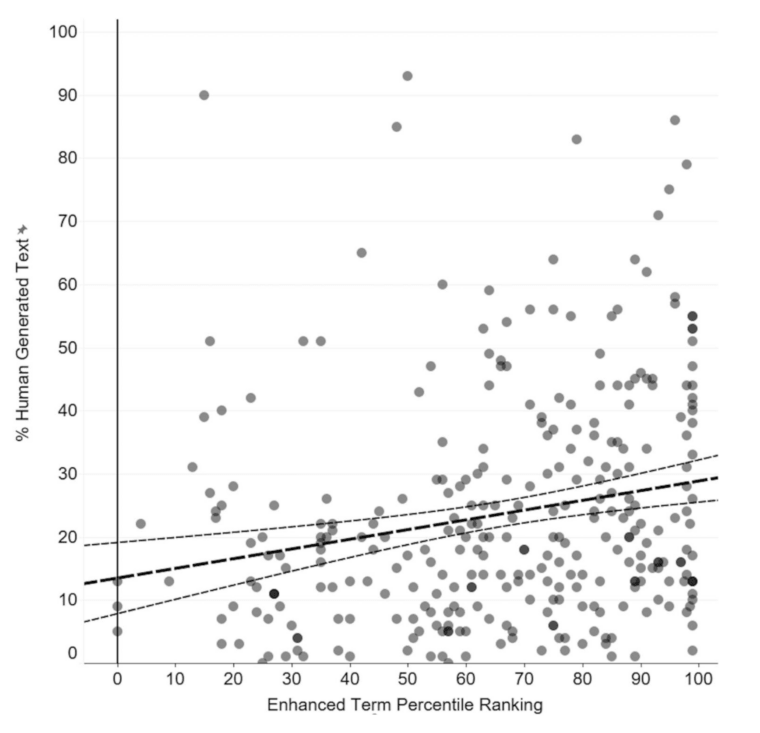
Figure reproduced from Harfe & Thomas (2026), “Quantitative Analysis of Generative AI Text Usage and Identification of Factors Influencing Text Choice,” TechTrends. [https://doi.org/10.1007/s11528-026-01182-5] Licensed under CC BY 4.0.
What this means for instructors and institutions
Dr. Harfe’s course is not a template to be copied wholesale. The topic, the student population, and the tool were all choices made in a specific context. But the logic underneath them travels.
Building AI into an assignment rather than designing around it changes the dynamic for students and instructors alike. It is no longer a game of cat and mouse, and instead focuses on the reflection of AI use across the writing process. That’s a more productive conversation, and it’s one that traditional essay design cannot reliably start.
Word-level transparency makes that conversation possible to have with data behind it. Where AI detectors deliver verdicts, Authorship delivers a record. That distinction matters for instructors trying to understand what is happening in their courses and for administrators building AI policies that need to hold up over time.
One of the more persistent worries in higher ed right now is that students will simply hand their thinking over to AI entirely. The data here pushes back on that harder than a usage statistic can. Students in Harfe’s course had explicit, written permission to submit a 100% AI-generated essay and receive full credit. The assignment instructions stated that directly. The only additional requirement was a reflection essay explaining their choices. Despite that, only two of 310 students made no edits to the AI draft. The rest engaged. The students who engaged most deeply were also the strongest academic performers. They did not just happen to engage; they chose to, even though they had every reason not to.
That is worth sitting with. It does not resolve every concern about AI in academic writing, but it does suggest that assignment design has more leverage than most institutions have given it credit for.
“It’s really important to show students what AI can be used for: the good, the bad, the ugly, and then let them make decisions on when and how they should use it in their future lives. Grammarly Authorship is a tool that facilitates that process for faculty in a more collaborative way with students.”
— Dr. Brian Harfe, Professor and Associate Provost, University of Florida
The peer-reviewed study “Quantitative Analysis of Generative AI Text Usage and Identification of Factors Influencing Text Choice” was published in TechTrends in April 2026. Read the full study.