About Florida Atlantic University
Florida Atlantic University is a student-centered public research university based in Boca Raton and part of Florida’s State University System. Florida Atlantic serves more than 31,000 undergraduate and graduate students across six campuses along Florida’s southeast coast and is ranked among the top public universities by U.S. News & World Report. The university pairs broad access with high-impact teaching and research to prepare graduates for success in today’s workforce.
The challenge: Help every student, without adding grading burden to instructors
Florida Atlantic University’s leaders wanted to remove barriers for students from varied backgrounds, especially first-years and multi-language learners, without turning support into remediation or adding workload for faculty. The goal was simple: help students bring stronger drafts to class so faculty could focus on ideas, argument, and feedback.
Florida Atlantic University’s approach: Access for all, autonomy for instructors
Florida Atlantic paired campus-wide availability with instructor autonomy. In some writing-intensive courses, faculty offered light onboarding; elsewhere, students adopted organically. The support fits where students already write (Word, Google Docs, Outlook, Gmail) so adoption didn’t require new platforms or workflows. Faculty often used it as a first line of instruction for recurring mechanics before digging into structure and argument.
- Provide campus-wide access to all students, with light instructor onboarding in select writing-intensive courses.
- Fit into existing workflows across Word, Google Docs, Outlook, Gmail, and the browser extension (no new platforms).
- Focus on pedagogy by using Grammarly as a “first line of instruction” on mechanics to protect time for ideas and argument.
What changed for students: Clearer writing, higher completion rates
With support visible and always available, Florida Atlantic University observed higher course completion, better term-to-term completion rates (with a pronounced first-year signal), improved GPA, and within-term and year-over-year writing gains.
“Grammarly provides a rich usage dataset to the institution. It is reliable, timely, and statistically sound. We used the data to help our student-success initiatives.”
Dr. Ying Liu, Assistant Provost of Institutional Effectiveness and Analysis, Florida Atlantic University
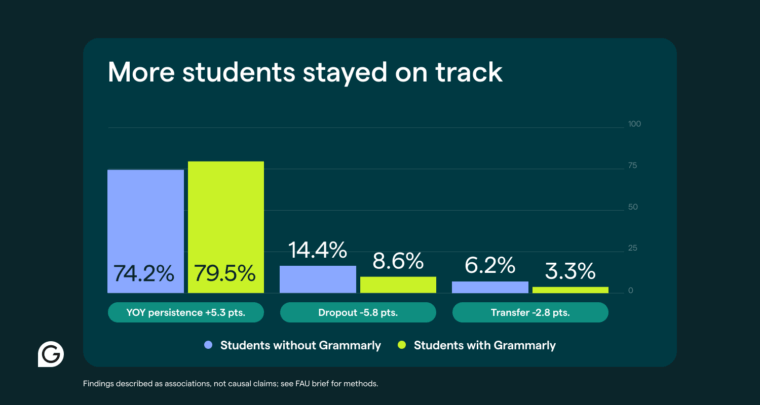
More students stayed on track
Florida Atlantic’s data showed a +5.3-point persistence lift, with fewer students dropping or transferring mid-program. Completion rose to 79.5% for Grammarly users compared with 74.2% for peers, while dropout and transfer each declined several points.
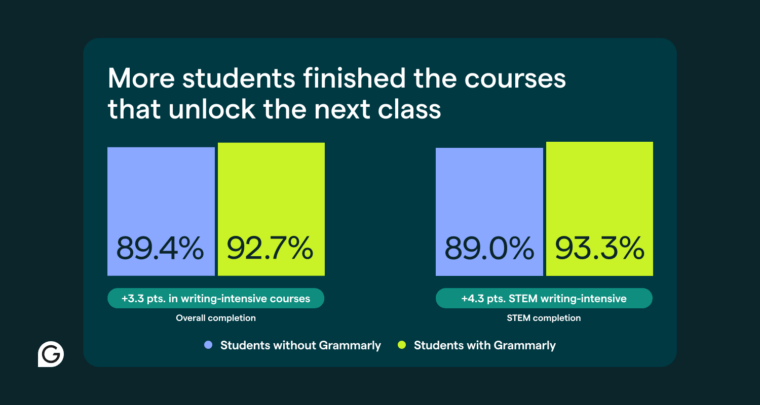
More students finished the courses that unlock the next class
Completion improved by +3.3 points across all writing-intensive courses and by +4.3 points in STEM sections. These gateway-course gains indicate that students using Grammarly were more likely to finish the courses required for degree progress.
Students’ writing improved term-to-term and year-to-year
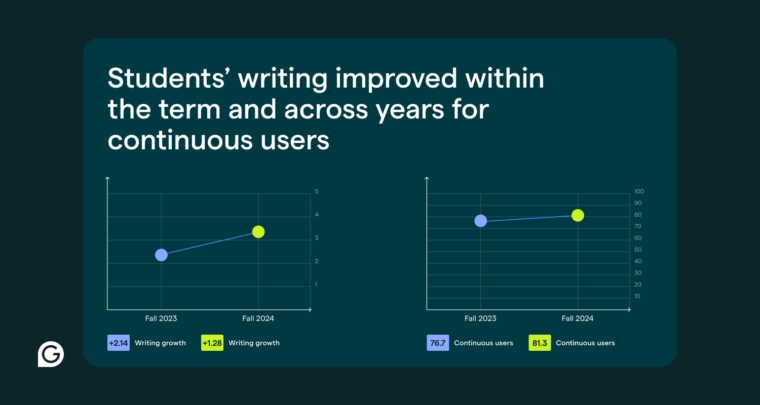
Writing performance scores rose +2.14 points in Fall 2023 and +1.28 in Fall 2024, with continuous users improving from 76.7 to 81.3 year over year. These trends suggest ongoing skill development rather than short-term correction.
Consistent use aligned with higher GPAs
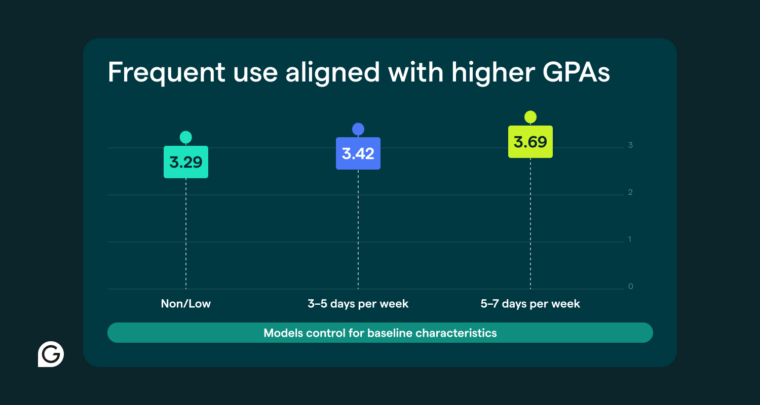
Frequent users achieved an average GPA of 3.69, about 0.4 points higher than non- or low-frequency users (3.29). Models in the Florida Atlantic University analysis controlled for baseline GPA and demographics, reinforcing that the trend aligns with habitual engagement.
What changed for faculty: Fewer mechanical corrections, more meaningful feedback
Faculty describe the support as a classroom pressure release: fewer repeated errors make drafts easier to read for meaning, and time shifts to guiding structure and argument. Because the assist happens in the student’s own draft, patterns become visible and changeable.
How Florida Atlantic University made it work
Rollout choices that travel well: keep access broad, keep friction low, and focus on momentum metrics that matter.
- Lead with access + choice. Campus-wide availability; instructors adopt where it fits pedagogy.
- Keep support low-barrier. Private, on-demand help reduces help-seeking friction, especially for multi-language learners.
- Anchor to student-success metrics. Track completion, retention, first-year momentum, STEM effects, writing growth, and GPA trends.
- Fit into existing ecosystems. Meet students where they write (Word, Google, Outlook, Gmail; browser plugin as needed).
Florida Atlantic’s experience points to a simple pattern: when support is available to every student and is integrated into the environments where they already write, more students keep moving forward. With access at scale and instructor autonomy, Florida Atlantic observed higher course completion and year-to-year persistence (especially for first-year and STEM students) alongside writing and GPA gains. At the same time, faculty shifted time to higher-order feedback. Florida Atlantic will continue to monitor outcomes and share lessons with peers.
See the Florida Atlantic research brief for a snapshot of the study, or dive into the technical report for the deeper analysis.