Authorship availability expands to Superhuman’s AI-native writing surface with richer attribution and default-on tracking for higher education
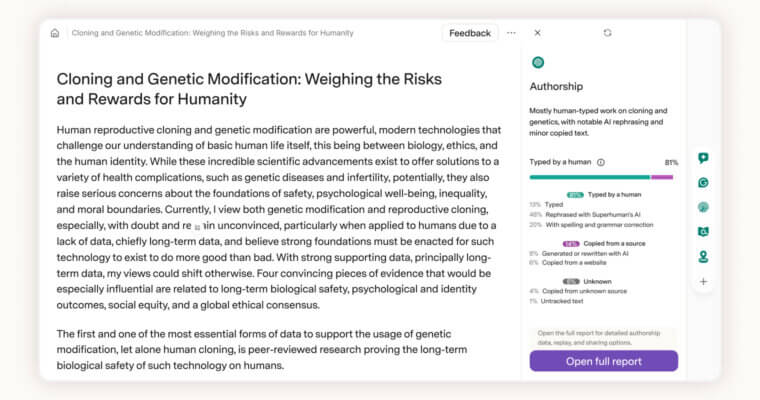
SAN FRANCISCO—March 10, 2026—Superhuman, the productivity platform bringing AI to wherever people work, today launches agent-specific attribution in its process tracker, Grammarly Authorship, and default-on availability of the tool in its writing surface, docs. These updates give students and educators clearer visibility into when and how AI is used in the writing process.
Despite widespread adoption by educators—90% use AI in their own work and nearly half in their teaching—most remain unsure how to use it effectively, and institutions are seeking ways to govern AI adoption at scale.
Superhuman (formerly Grammarly) is committed to supporting educators and institutions as they move from reactive AI policies to intentional AI-assisted learning, fostering environments that help students get real-world experience with the tools shaping the workplace.
“It is not enough to tolerate AI; we must teach students how to use it responsibly and transparently,” said Janet Mitchell-Lambert, professor of English at Cerritos College. “Tools that make the writing process visible allow us to shift from policing to teaching — grounding integrity conversations in evidence rather than probability. As AI evolves, transparent authorship models are essential to maintaining academic standards while helping students grow as writers and develop agency.”
Since launching in beta in October 2024, Authorship has helped bring transparency to the writing process by identifying which parts of a document were human-created, AI-generated, or AI-edited. More than 5 million Authorship reports have been generated by students to show their instructors how they’re using AI responsibly. At Rowan-Cabarrus Community College, this led to a 96% reduction in academic integrity violations in one semester.
To continue deepening its support for students, Superhuman launched docs for the 2025-26 school year, providing a workspace with agents that offer proactive, appropriate support for academic writing.
Authorship keeps pace with AI advancement
For the first time, Authorship in docs can not only attribute AI use but also identify whether and how a writer used specific Superhuman AI agents.
Because Authorship can distinguish if AI and agents were used for research support, content generation, or revision feedback, it helps educators and institutions move beyond blanket AI policies toward more nuanced conversations about which types of AI use are helpful and appropriate for different assignments.
“Agent-specific attribution with Authorship lays the groundwork for rethinking assessment in the AI era,” said Jenny Maxwell, Head of Superhuman for Education. “With insights from Authorship, educators can better embed AI into teaching to evaluate the learning journey rather than just the final output. This positions institutions to lead in AI-enabled pedagogy rather than react to it defensively.”
Students also benefit from agent-level attribution, developing awareness of which tasks they’re delegating to AI and how they can use AI tools most authentically.
A sampling of Superhuman’s first-party agents for writing includes:
- Reader Reactions: Predicts how a specific audience will respond to writing and suggests improvements
- Citation Finder: Finds sources that support or challenge claims and creates correctly formatted citations
- Proofreader: Acts as an in-line editor that improves clarity, flow, and correctness while matching style
- Fact Checker: Scans your text and finds relevant evidence that supports, disputes, or refutes your claims
Improving access and outcomes for students and educators
Authorship now is available in docs and is on by default. Students no longer need to manually turn the tool on, but they retain control over their experience with Authorship. For example, they still need to proactively share the report with their instructor.
“With Authorship in docs, we wanted to make things simpler for students,” said Jennifer van Dam, Senior Product Manager. “Now they don’t need to remember to turn Authorship on. The tool will automatically keep a record of what they wrote and where AI helped, so if they ever need to show how their work came together, they can. And the key part is that students stay in control. No one sees that report unless and until they choose to share it.”
Authorship protects students from false AI-detection flags and empowers educators with insights to inform how they incorporate AI into their assignments. Admins for educational institution accounts can now also configure which AI agents are available to students or faculty.
This announcement extends the company’s vision of bringing Authorship to all the places where students work. Authorship is also available in Google Docs, Microsoft Word, and Canvas.
Learn more:
- Grammarly Authorship is rolling out in docs for all users at no additional cost. Users can open a new doc in app.grammarly.com to start using Superhuman’s first-party AI agents in the right-hand panel.
- Authorship has been recognized by Fast Company and EdTech Breakthrough as an innovative edtech tool.
- Find more information on Superhuman’s first- and third-party agents here. For details about agent availability by plan, visit our Plans page.
- Learn more about Authorship in Docs here.
About Superhuman
Superhuman (formerly Grammarly) is the AI productivity platform on a mission to unlock the superhuman potential in everyone. The Superhuman suite of apps and agents brings AI wherever people work, integrating with over 1 million applications and websites. The company’s products include Grammarly’s writing assistance, Coda’s collaborative workspaces, Mail’s inbox management, and Go, the proactive AI assistant that understands context and delivers help automatically. Founded in 2009, Superhuman empowers over 40 million people, 50,000 organizations, and 3,000 educational institutions worldwide to eliminate busywork and focus on what matters. Learn more at superhuman.com.