
As AI tools become more common, so do expectations around transparency. If you’ve used ChatGPT to help with your writing, you may need to cite it, especially in academic or professional work. So how do you cite ChatGPT the right way?
This guide walks you through how and when to disclose AI use and provides step-by-step instructions, examples, and citation generators for APA, MLA, and Chicago styles.
Table of contents
Quick reference table for citing ChatGPT
How to cite ChatGPT in APA style
How to cite ChatGPT in MLA style
How to cite ChatGPT in Chicago style
How to disclose AI use in your writing
Grammarly’s features for original, authentic content
When should you cite ChatGPT?
You should cite ChatGPT when it meaningfully contributed to your work, such as by generating text, shaping ideas, or providing analysis, especially in academic or professional settings where transparency is expected.
With that said, different audiences may have different expectations when it comes to citing AI tools like ChatGPT. Academic institutions and teachers, for instance, may require citation or disclosure even for small contributions, while online shoppers may not care when product descriptions are AI-generated.
If you write in an academic or professional setting, check with your organization for guidance on when and how to use and disclose AI. When in doubt, it’s best to err on the side of transparency and disclose how AI assisted your work.
Quick reference table for citing ChatGPT
Before diving into detailed examples for each citation style, here’s a comparison of how to cite ChatGPT in APA, MLA, and Chicago styles:
| Style | Citation Format | Example |
| APA | OpenAI. (Year). ChatGPT (Mar 27 version) [Large language model]. https://chat.openai.com/ | OpenAI. (2025). ChatGPT (Mar 27 version) [Large language model]. https://chat.openai.com/ |
| MLA | OpenAI. ChatGPT, Mar 27 version, OpenAI, 2025, https://chat.openai.com/. | OpenAI. ChatGPT, Mar 27 version, OpenAI, 2025, https://chat.openai.com/. |
| Chicago | OpenAI. ChatGPT. Large language model. Mar 27, 2025. https://chat.openai.com/. | OpenAI. ChatGPT. Large language model. Mar 27, 2025. https://chat.openai.com/. |
How to cite ChatGPT in APA style
In APA 7, AI-generated content, such as ChatGPT responses, may be treated as personal communication if the output is not retrievable by others. If the ChatGPT output is not retrievable by others (e.g., a private chat), APA treats it as personal communication. In this case, include an in-text citation but not a reference list entry.
APA in-text citation
APA recommends citing ChatGPT as a personal communication when referring to outputs that are not publicly accessible.
Example:
(OpenAI, personal communication, March 15, 2024)
APA reference entry
Since personal communications are not recoverable by others, APA does not require a reference list entry.
However, if the output is retrievable (for example, via a shared link or appendix), or if your institution or publisher requires it, include a full reference entry. Here’s a suggested format:
However, if your institution or publisher prefers a full citation, here’s a suggested format:
Suggested full citation:
OpenAI. (2024). ChatGPT (March 15 version) [Large language model]. https://chat.openai.com/
Tips for citing ChatGPT in APA style:
- Use a description in square brackets (e.g., “[Large language model]”) to clarify the type of source—APA recommends this for nonstandard formats like software, datasets, or AI tools.
- Treat outputs as personal communication if they’re not retrievable by others (like a private chat).
- No reference list entry is needed for personal communication, but check your instructor’s or publisher’s policy—they may prefer a full citation anyway.
- Consider adding the transcript as an appendix and referring to it in the text if the conversation played a major role in your work.
- Use Grammarly’s APA citation generator to speed up the process.
How to cite ChatGPT in MLA style
MLA views AI tools like ChatGPT as containers, similar to websites or apps. Cite OpenAI as the author and include the prompt or a brief description of the interaction. Let’s look at the format.
MLA in-text citation
Put “OpenAI” in parentheses to cite it as an author.
Example:
(OpenAI)
If you’re referencing a specific interaction, you can include the prompt in your prose and follow it with the citation.
Example in prose:
When prompted to “Summarize Plato’s Allegory of the Cave,” ChatGPT described it as a metaphor for ignorance and enlightenment (OpenAI).
Alternatively, you can briefly describe the interaction:
According to a response generated by ChatGPT about digital privacy, personal data has become “a form of currency in the online economy” (OpenAI).
MLA works cited entry
MLA suggests including your prompt in your citation entry to clarify what was generated.
Example:
OpenAI. ChatGPT, 15 Mar. 2024, https://chat.openai.com. Prompt: “Explain how photosynthesis works.”
It also recommends mentioning the prompt in your prose, such as in the example below:
When prompted with “Summarize the theme of The Great Gatsby,” ChatGPT responded that the novel explores “the illusion of the American dream and the emptiness behind material success” (OpenAI).
Tips for citing ChatGPT in MLA style:
- Include the prompt if it shaped the AI’s response—either in the prose or at the end of the works cited entry.
- Italicize the title (e.g., ChatGPT) and list OpenAI as the publisher, just like you would with a website or an app.
- Use a clear date to show when you accessed the tool, since responses may change over time.
- Use Grammarly’s MLA citation generator to instantly create a citation.
How to cite ChatGPT in Chicago style
Chicago provides options for citing AI in either notes and bibliography or author-date format, depending on your discipline, and treats ChatGPT as software or online content. The style recommends including a date and URL.
Below are examples for both.
Chicago notes and bibliography
Footnote example:
OpenAI, ChatGPT, Mar. 15, 2024, https://chat.openai.com/.
Bibliography example:
OpenAI. ChatGPT. Mar. 15, 2024. https://chat.openai.com/.
Chicago author-date
In-text citation example:
(OpenAI 2024)
Reference list entry:
OpenAI. 2024. ChatGPT. March 15. https://chat.openai.com/.
Tips for citing ChatGPT in Chicago style:
- Choose the system (notes and bibliography or author-date) based on your discipline: The humanities often use notes and bibliography; the sciences use author-date.
- Treat ChatGPT like software or online content with a date and URL. Add a description (e.g., “Large language model”) if it helps with clarity.
- Add the prompt to the text (not the footnote or bibliography) if it adds important context to what was generated.
- Include the full transcript in an appendix and reference it in your citation for heavily used conversations.
- Use Grammarly’s Chicago citation generator to quickly cite your use of AI.
How to disclose AI use in your writing
In addition to (or instead of) a formal citation, some institutions may ask you to disclose your use of AI tools like ChatGPT in a statement or footnote. This is especially common in academic or research settings. Always check your instructor’s or publisher’s policy.
Example disclosure:
Portions of this paper were generated with the help of ChatGPT, a large language model developed by OpenAI, to assist with outlining and phrasing.
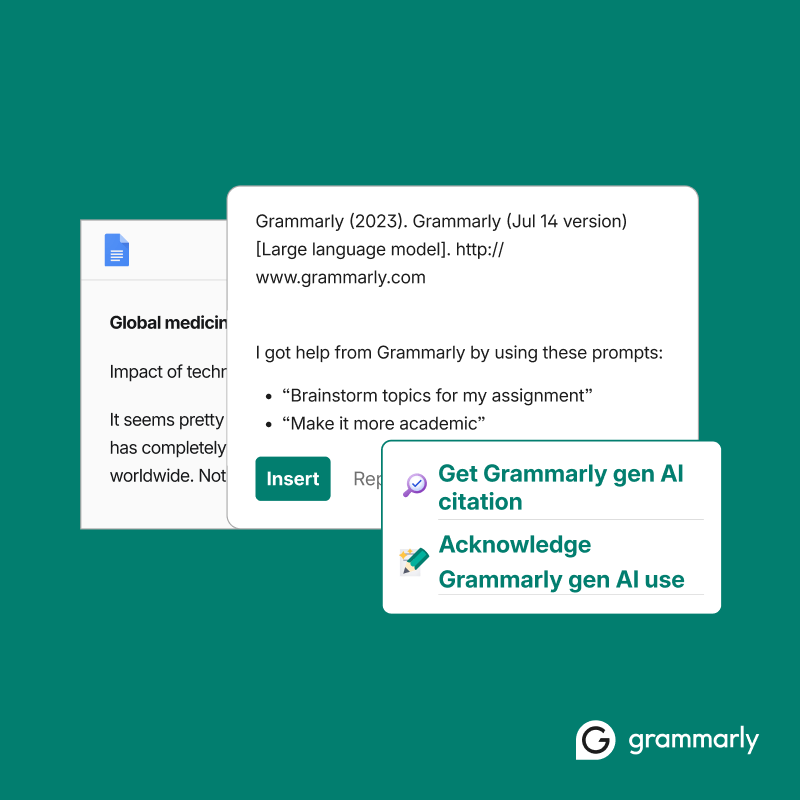
Grammarly allows you to instantly cite and disclose your AI use from wherever you’re writing. Simply click the Grammarly button in the lower-right corner of your document or text box to generate citations or disclosures.
Grammarly’s features for original, authentic content
Citing and disclosing ChatGPT use is just one part of using AI responsibly. Creating original, authentic content also means making sure your work reflects your voice and that you’re giving credit where it’s due, whether you’re referencing an AI tool or a human source.
Grammarly is designed to help with both. Its suite of features makes it easy to stay transparent and aligned with academic or workplace standards:
- AI detection gives you a gut check on how your writing may be perceived and helps you identify where to personalize.
- Plagiarism detection compares your work against online sources and highlights text that may need to be rephrased or attributed.
- Citations help you easily and clearly acknowledge your sources—whether you’re referencing AI tools, websites, or other materials—making it easier to maintain transparency and meet academic or professional standards.
- Grammarly Authorship tracks how your document was created, giving you a clear record of whether it was typed, pasted, or generated by AI. This detailed report can be useful for proving originality and navigating questions about how your writing was developed. This is particularly helpful for students or professionals working under AI use policies that require transparency and proof of authorship.
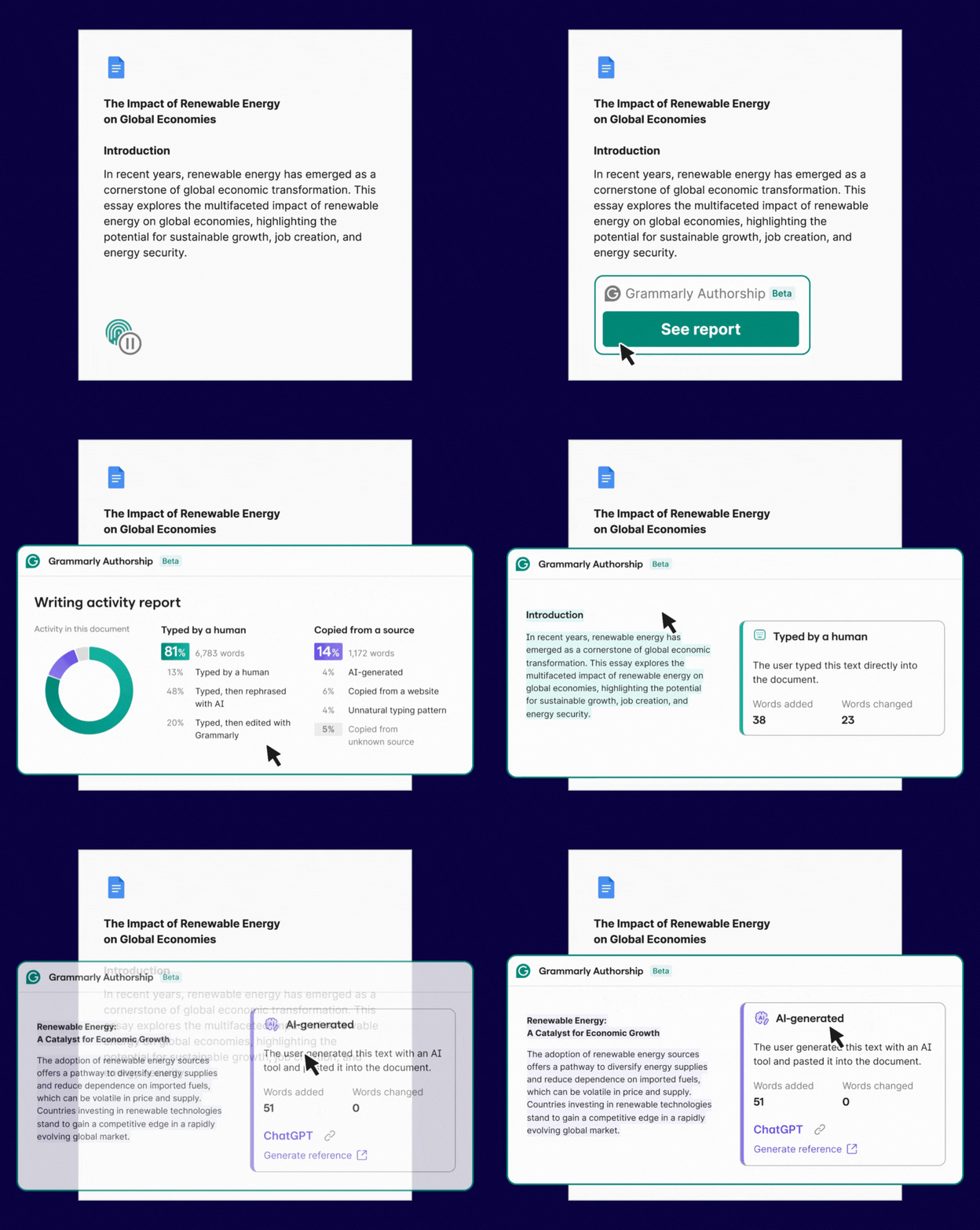
By combining these tools, you can ensure transparency, proper attribution, and originality in your work, even if you use an AI tool like Grammarly or ChatGPT in your process.
Final thoughts
As AI becomes a regular part of the writing process, responsible use includes knowing when and how to acknowledge its assistance. Grammarly takes the guesswork out of proper attribution. With features that help you disclose AI use clearly and generate fully formatted citations for your sources, you can feel confident that your work meets the expectations of your instructor, publisher, or workplace, no matter what style guide you’re following.
How to cite ChatGPT FAQs
How do you cite ChatGPT as a reference?
To cite ChatGPT as a reference, you’ll need to follow the format recommended by your style guide. APA treats ChatGPT as a personal communication (meaning it does not require a reference list entry), while MLA and Chicago offer formats for citing online tools with dates and URLs. Examples for each are included in this article.
How do you cite AI in APA 7?
In APA 7, how you cite AI-generated content depends on whether the output is retrievable by others.
If the content is not retrievable (such as a private ChatGPT conversation), cite it as a personal communication. In this case, include an in-text citation but not a reference list entry.
If the content is retrievable (for example, via a shared link or appendix), cite it as a source. Include both an in-text citation and a full reference list entry, using the company that created the AI as the author and the name of the tool as the title.
For example, an in-text citation for ChatGPT would appear as “(OpenAI, 2023).” A corresponding reference entry should include the author, date or version, a description such as “[Large language model],” and the URL.
Be sure to include the date you used the tool and, when relevant, describe how it contributed to your work for transparency.
What’s the correct way to cite ChatGPT in MLA?
MLA suggests including your prompt in your citation entry to clarify what was generated. It also recommends mentioning the prompt in your prose. Use the prompt as the title in quotation marks, followed by the tool name in italics, version, publisher (OpenAI), date, and URL.
How do you reference ChatGPT Harvard style?
Harvard referencing generally includes the author (OpenAI), year, title (ChatGPT), date accessed, and the URL. Example: OpenAI. (2024). ChatGPT. Accessed 15 Mar. 2024. https://chat.openai.com/.
Can I include a disclosure instead of a citation?
Yes. In some cases—especially in academic settings—a brief disclosure of AI use is acceptable or even preferred. Check with your instructor, publisher, or organization to confirm what’s required.