Key takeaways
- AI detectors analyze writing patterns to estimate if content was AI-generated.
- AI detection isn’t foolproof—false positives and negatives are possible.
- As a best practice, combine AI detection with tools like Grammarly Authorship and plagiarism detection.
With AI-generated content becoming more and more common, you might wonder how to determine if something was written by a human or AI. Educators and professionals in content moderation and publishing often turn to AI detectors to help determine whether text was generated by artificial intelligence. These digital tools analyze writing style, structure, and patterns to estimate the likelihood of AI involvement.
But how do these detectors actually work? And can they really tell the difference between human and AI writing? In this article, we’ll break down the basics of AI detection, its strengths and weaknesses, and how to use these tools responsibly.
Table of contents
How reliable are AI detectors?
AI detectors vs. plagiarism checkers
How Grammarly’s AI detection works
Best practices for using AI detectors
How AI detectors work takeaways
What are AI detectors?
AI detectors estimate the likelihood that content—text, images, code, or multimedia—was generated by artificial intelligence. They look for patterns, structures, and metadata to differentiate AI-created content from human-produced work. Various industries and educational institutions may rely on AI detectors for content verification, fraud detection, academic integrity, and media authentication. However, because AI technology is constantly evolving, AI detection is inexact. For this reason, AI detection tools are most effective when used alongside other methods such as plagiarism detection, citing sources, and authorship tracking, which records how a piece of content was created and edited over time.
So, how do AI detectors actually work? Here’s a closer look at the methods they use to spot AI writing.
How do AI detectors work?
AI detectors use machine learning models to recognize patterns that distinguish AI-generated content from human writing. These models are trained on large datasets containing both AI- and human-written text, allowing them to identify key differences in style, structure, and predictability.
Key methods AI detectors use
To estimate whether a text was AI-generated, AI detectors analyze several characteristics:
- Sentence structure and predictability: AI-generated text often follows consistent patterns, whereas human writing tends to be more varied and unpredictable.
- Repetition and uniformity: AI models frequently repeat phrases, while human writers naturally introduce more variation.
- Metadata traces: Some AI tools embed hidden markers in their output, which detection models can identify.
- Comparison with known AI outputs: Some detectors compare text to a database of known AI-generated content. This method is less effective for advanced AI models that can generate highly varied outputs.
Perplexity and burstiness
Some AI detectors measure statistical signals like perplexity and burstiness because these metrics help quantify how predictable and uniform a piece of writing is.
- Perplexity measures how predictable a sequence of words is. AI-generated text tends to have lower perplexity because it usually follows common linguistic patterns. Human writing, on the other hand, often includes unexpected word choices, making it higher in perplexity.
- Burstiness refers to variations in sentence length and structure. Human writing naturally includes a mix of short and long sentences, which creates a dynamic rhythm. AI-generated text tends to be more uniform.
By analyzing these factors together, AI detectors estimate the likelihood that text is AI-generated. However, these tools are inexact and can provide only probabilities, not definitive proof. Because no AI detector is perfect, they work best when combined with other originality checks. Grammarly’s Plagiarism Checker and Authorship feature provide a more complete picture of content authenticity.
How reliable are AI detectors?
Several things may impact how well an AI detector performs:
- Text length: Short passages are harder to analyze, while longer texts provide more patterns for detectors to evaluate.
- AI model sophistication: Many newer AI models produce more human-like writing, which can make AI-generated text trickier to spot.
- Mixed AI-human editing: AI-generated text that’s revised by a human can be harder to identify.
- Writing style variability: AI detectors may struggle with creative or unconventional writing styles that don’t fit the training data.
Limitations of AI detectors
While AI detectors can be useful, it’s crucial to understand their limitations in order to use them responsibly. Limitations include:
- False positives and false negatives: AI detectors are not 100% accurate and can sometimes misclassify text. A false positive occurs when human-written content is mistakenly flagged as AI-generated, while a false negative happens when AI-generated text goes undetected. This can lead to unfair accusations or missed cases of AI use.
- Bias in detection: AI detectors may struggle with certain writing styles. Creative writers, students who are developing their skills, and writers who speak English as an additional language may stump AI detectors. Because these tools analyze patterns based on training data, they may unfairly flag certain writing as AI-generated simply because it differs from the writing styles they were trained on.
- Difficulty detecting advanced AI models: AI-generated content is getting better—or more human-like—as the technology evolves and AI detection is struggling to keep up. Advanced models generate text with more variability, making detection increasingly difficult. AI detectors often lag behind the latest AI advancements, reducing their reliability.
- Inability to provide definitive proof: AI detection tools provide probabilistic results, not concrete evidence. A high AI-likelihood score doesn’t mean the text was AI-generated, just that it shares characteristics with AI writing. These tools should be used as a guide rather than a final judgment.
- Overreliance can lead to misuse: When used in isolation, AI detectors can lead to unfair academic penalties, incorrect content moderation decisions, or unnecessary suspicion. They work best when used alongside other verification methods, such as plagiarism detection, writing history analysis, and human judgment.
AI detectors vs. plagiarism checkers
AI detectors and plagiarism checkers are both used to assess content originality, but they serve different purposes and analyze text in distinct ways. AI detectors estimate whether text was AI-generated, while plagiarism checkers identify content that matches existing sources.
| AI detectors | Plagiarism checkers | |
| Purpose | Estimates whether text was AI-generated | Checks if text matches existing sources |
| How it works | Analyzes writing patterns, predictability, and structure | Compares text against a database of published content |
| Detection focus | AI-generated content | Copied or improperly cited content |
| Reliability | Probabilistic, may misidentify human or AI text | More definitive, but may not catch paraphrased plagiarism |
As AI use proliferates, we suggest using both tools for a more comprehensive content verification process.
How Grammarly’s AI detection works
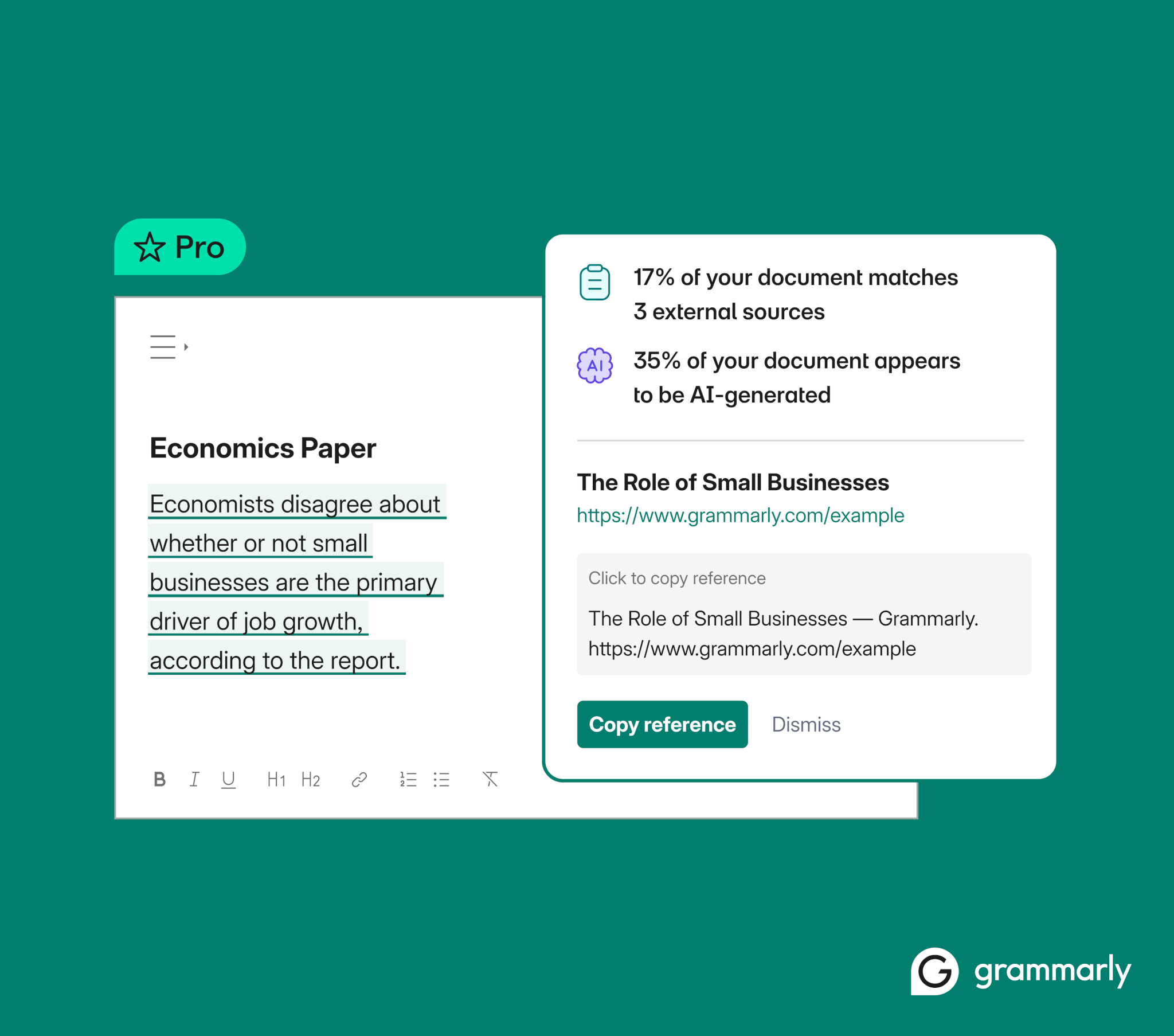
Grammarly’s AI Detector provides clarity and transparency so people can use AI responsibly. When a document is scanned, the system analyzes it in smaller sections, evaluating language patterns commonly associated with AI-generated text. Based on this analysis, Grammarly provides a percentage score estimating how much of the document may have been generated by AI.
The model is trained on hundreds of thousands of human- and AI-generated texts, enabling it to identify distinguishing statistical signals between the two. It’s built to evaluate content generated by a wide range of AI tools—including ChatGPT, Gemini, Claude, and others—while minimizing false positives, making human-written work less likely to be incorrectly flagged.
For Grammarly Pro users, the AI detection experience goes beyond a single score. You can see which sections of your writing were flagged and why, along with clear explanations that make results easier to interpret. Our built-in AI Rewriter agent lets you revise flagged passages in a single click—improving clarity and originality without disrupting your workflow. It can also identify where citations may be needed and suggest relevant sources.
AI detection is just one part of our broader approach to supporting academic integrity. We also offer:
- Grammarly Authorship: Track how a document was created. When enabled, Authorship provides a report showing what was typed by a human, generated with AI, or pasted and edited—offering a clearer record of the writing process.
- Plagiarism detection: Compare text against a vast database of online sources to identify potential uncredited material.
- Citations: Generate properly formatted citations, including for AI-assisted content, to promote transparency.

Together, these tools combine detection, revision, and documentation to support originality and responsible AI use.
Best practices for using AI detectors
AI detectors can provide insight, but to ensure a fair and responsible approach to evaluating content, it’s important to understand their limitations and use them thoughtfully. Consider these best practices:
- Acknowledge limitations. AI detectors can sometimes misidentify text, resulting in false positives or negatives. Consider their findings as one data point, rather than conclusive evidence.
- Cross-check with multiple tools. No detector is perfectly accurate. Using multiple AI detection tools can provide a broader perspective and help minimize errors.
- Learn to recognize typical AI writing characteristics. AI-generated text often adheres to predictable patterns, lacks subtlety, and may repeat phrases. Being aware of these characteristics can help you interpret detection results more effectively. Evaluate context and intent. A flagged result should prompt a closer review rather than an automatic conclusion. Consider the writer’s
- typical style, readability, and phrasing. If the text seems significantly different from their usual work, AI detection can serve as a starting point for further investigation—not as the final word.
- Be transparent. Clearly communicate what role AI detection plays in academic, professional, or editorial contexts. Consider creating standards for content verification that include more than one method of AI detection to avoid reliance on automated assessments.
- Use AI detection as part of a broader originality check. For the most reliable evaluation, combine AI detection with plagiarism checkers, citation verification, and tools like Grammarly Authorship to get a fuller picture of content authenticity.
How AI detectors work: takeaways
AI detectors scan text for clues that hint at AI involvement. They analyze sentence structure, predictability, and writing patterns using machine learning models trained on both human-written and AI-generated text. Some even go a step further by checking metadata or comparing content to known AI outputs.
But no AI detector is perfect. As AI-generated content becomes more sophisticated, detection methods will need to evolve just as quickly. That’s why it’s important to use AI detection alongside other verification methods—such as plagiarism checkers, citation tools, and authorship tracking—to get a fuller picture of content authenticity. While AI detectors can provide useful insights, nothing beats human judgment. Use them as a guide—not a verdict—to make informed decisions about originality and attribution.
How AI detectors work FAQs
How do AI checkers work?
AI checkers analyze text patterns, sentence structures, and stylistic choices to estimate the likelihood that content was generated with AI. They use machine learning models trained on large datasets of AI-generated and human-written text to identify probable AI usage, but their accuracy can vary.
Are AI detectors really accurate?
Yes, AI detectors are accurate, but no AI detector is 100% accurate. You should never rely on the results of an AI detector alone to determine whether AI was used to generate content. AI detectors can identify patterns found in human writing and AI-generated text, but they cannot definitively conclude whether or not AI was used. These tools should be one part of a holistic approach to evaluating writing originality.
Why do AI detectors sometimes flag human-written content?
AI detectors rely on statistical patterns rather than deep comprehension, meaning they may misclassify text that is overly formal, repetitive, or lacks personal nuance. Writers who learned English as an additional language are particularly vulnerable to misclassification because their writing styles may differ from the datasets used to train AI detectors. This is why context, manual review, and additional verification tools are essential when assessing content originality.
Should I rely on AI detectors to verify content authenticity?
AI detectors can provide insight, but they should not be the sole method for verifying content authenticity. To assess originality, we suggest using AI detection alongside manual review and other tools, like Grammarly Authorship, which tracks the creation process, and AI citations, which allows writers to disclose when and how they used AI.
What happens if your writing gets detected as AI?
If your writing is flagged as AI-generated, what happens next depends on the context and the policies of your school or workplace. In academic settings, a flagged result may prompt further review, a request for clarification, or a conversation about how the work was created. Some institutions have specific guidelines about AI use and disclosure, while others evaluate cases individually. In professional environments, policies may vary depending on company standards or the nature of the work.
Because AI detectors can produce false positives, a detection result should not automatically be treated as proof of AI misuse. If you’re concerned, review the flagged sections, check your institution’s or employer’s AI policy, and be prepared to explain your writing process or provide documentation if needed.