Key takeaways
- AI detectors estimate the likelihood that text was AI-generated, but they’re not 100% accurate.
- Accuracy depends on factors like writing style, AI model complexity, and training data quality.
- Combine AI detection with proper citation practices and additional tools like Grammarly Authorship and plagiarism detection so you get a more accurate, well-rounded assessment of content originality.
As artificial intelligence (AI) becomes more common in classrooms and workplaces, questions about transparency are growing just as quickly. Many institutions now rely on AI detection tools to evaluate whether a piece of writing was generated by AI, but how dependable are those tools?
In this article, we’ll explain how AI detectors work, what affects their accuracy, where they fall short, and how to approach AI detection responsibly.
Table of contents
How accurate are AI detectors in practice?
What affects AI detector accuracy?
What is the most accurate AI detector?
Best practices for using AI detectors
Future advancements in AI detection accuracy
Final thoughts: Are AI detectors accurate?
How accurate are AI detectors in practice?
In practice, no AI detector is 100% accurate. Their accuracy can vary widely, depending on the tool being used, the AI model that may have generated the text, the quality of the detector’s training data, and how the content was created or edited. While some tools perform well on clear-cut cases of fully AI-generated text, results become less predictable in more complex or mixed scenarios.
AI detection tends to be more reliable when analyzing unedited text. But once AI-generated content is edited, paraphrased, or combined with human writing, the results become less predictable. Even small changes can affect how a detector evaluates the text.
This can lead to two common problems:
- False positives, where human-written text is incorrectly flagged as AI-generated
- False negatives, where AI-generated text goes undetected
Because AI detectors look for language patterns, not the actual writing history, they can’t confirm who wrote something. They can only assess whether the text resembles AI-generated content. In situations where authorship truly matters, such as in academic or professional evaluations, tools that track how a document was created, like Grammarly’s Authorship tool, offer much clearer insight into the writing process.
For this reason, AI detection is best used as a starting point for review rather than as final proof of authorship.
What affects AI detector accuracy?
No AI detector can guarantee definitive results. Accuracy depends on multiple factors:
The detection tool itself
Not all AI detectors are built the same way. They use different models, training data, and evaluation methods, which means the same piece of text can produce different results across tools.
The quality of training data
AI detectors learn from large datasets of both human- and AI-generated writing. If that data is limited or outdated, the tool may struggle to evaluate newer AI models or varied writing styles accurately.
Editing and hybrid writing
AI-generated text that has been revised, paraphrased, or combined with human input is significantly harder to classify. Even small edits can change the patterns detectors use to reach their conclusions.
Writing style and language background
Formal writing that is highly structured or writing from people who speak English as an additional language can sometimes resemble AI-generated patterns, which could increase the risk of human-written text being misclassified as AI text.
How do AI detectors work?
AI detectors use machine learning to analyze patterns in writing to estimate how much of your work appears to be written with AI. They are trained on large datasets that include both human-written and AI-generated text, which helps them recognize differences in structure, phrasing, and predictability.
Rather than understanding meaning or intent, AI detectors look for statistical signals. These may include how predictable the wording is, how varied the sentence structure appears, and whether certain phrasing patterns resemble common AI outputs. Some tools also compare text against known AI-generated samples to identify similarities.
Some of the key techniques used in AI detection include:
- Perplexity and burstiness analysis, which measures how predictable and varied a text is compared to typical AI-generated content
- Pattern matching, which identifies text similarities compared to known AI-generated content
- Statistical modeling, which uses machine learning algorithms to estimate the probability of AI involvement
How Grammarly’s AI detection works
Grammarly’s AI Detector provides clarity and transparency so people can use AI responsibly. When a document is scanned, the system analyzes it in smaller sections, evaluating language patterns commonly associated with AI-generated text. Based on this analysis, Grammarly provides a percentage score estimating how much of the document may have been generated by AI.
The model is trained on hundreds of thousands of human- and AI-generated texts, enabling it to identify distinguishing statistical signals between the two. It’s built to evaluate content generated by a wide range of AI tools—including ChatGPT, Gemini, Claude, and others—while minimizing false positives, making human-written work less likely to be incorrectly flagged.
For Grammarly Pro users, the AI detection experience goes beyond a single score. You can see which sections of your writing were flagged and why, along with clear explanations that make results easier to interpret. Our built-in AI Rewriter lets you revise flagged passages in a single click—improving clarity and originality without disrupting your workflow. It can also identify where citations may be needed and suggest relevant sources.
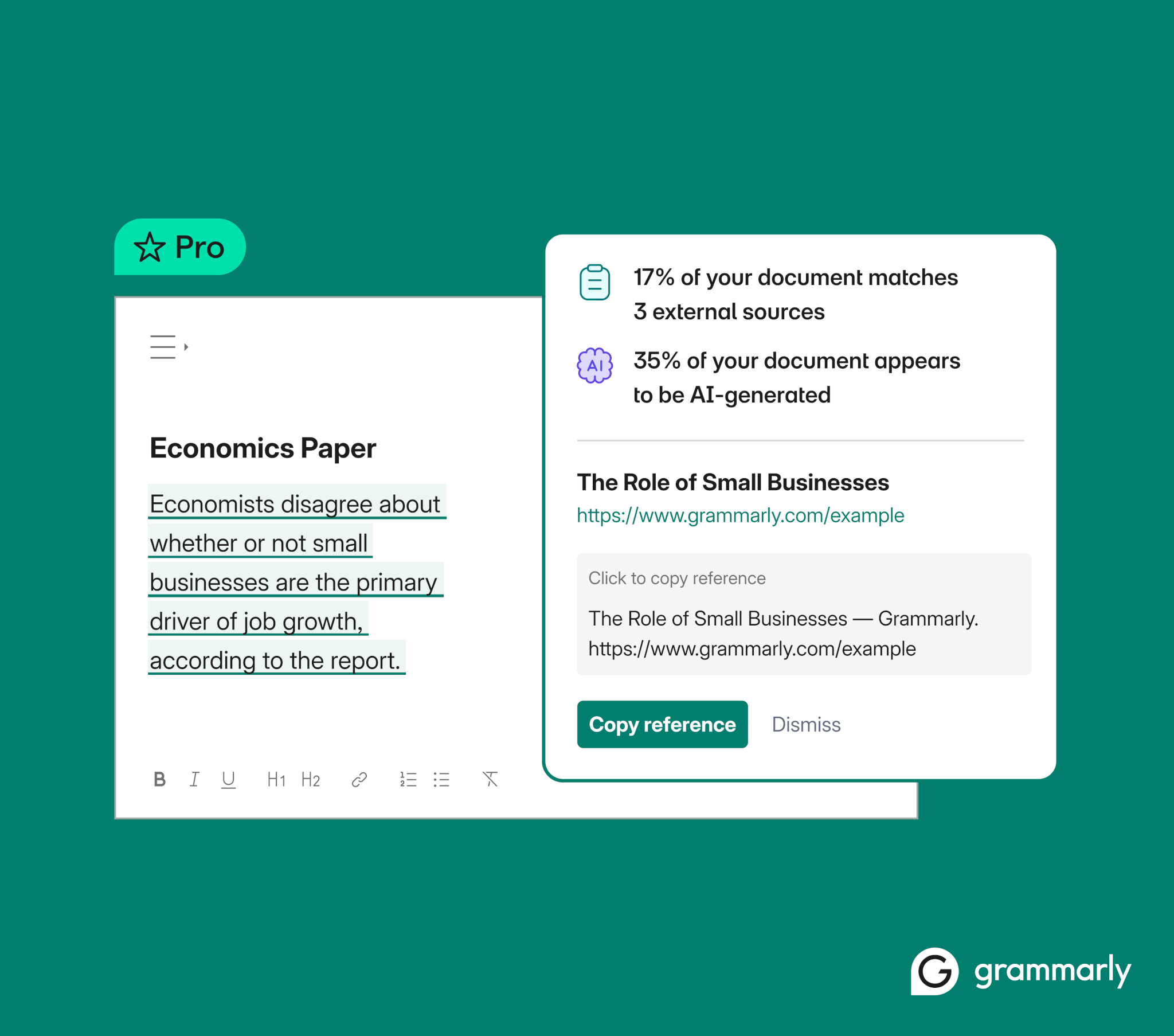
AI detection is just one part of our broader approach to supporting academic integrity. We also offer:
- Grammarly Authorship: Track how a document was created. When enabled, Authorship provides a report showing what was typed by a human, generated with AI, or pasted and edited—offering a clearer record of the writing process.
- Plagiarism detection: Compare text against a vast database of online sources to identify potential uncredited material.
- Citations: Generate properly formatted citations, including for AI-assisted content, to promote transparency.

Together, these tools combine detection, revision, and documentation to support originality and responsible AI use.
What is the most accurate AI detector?
There isn’t a single AI detector that performs perfectly in every scenario. When evaluating accuracy, it’s important to look beyond broad claims and consider how often a tool correctly identifies AI-generated text while avoiding false positives.
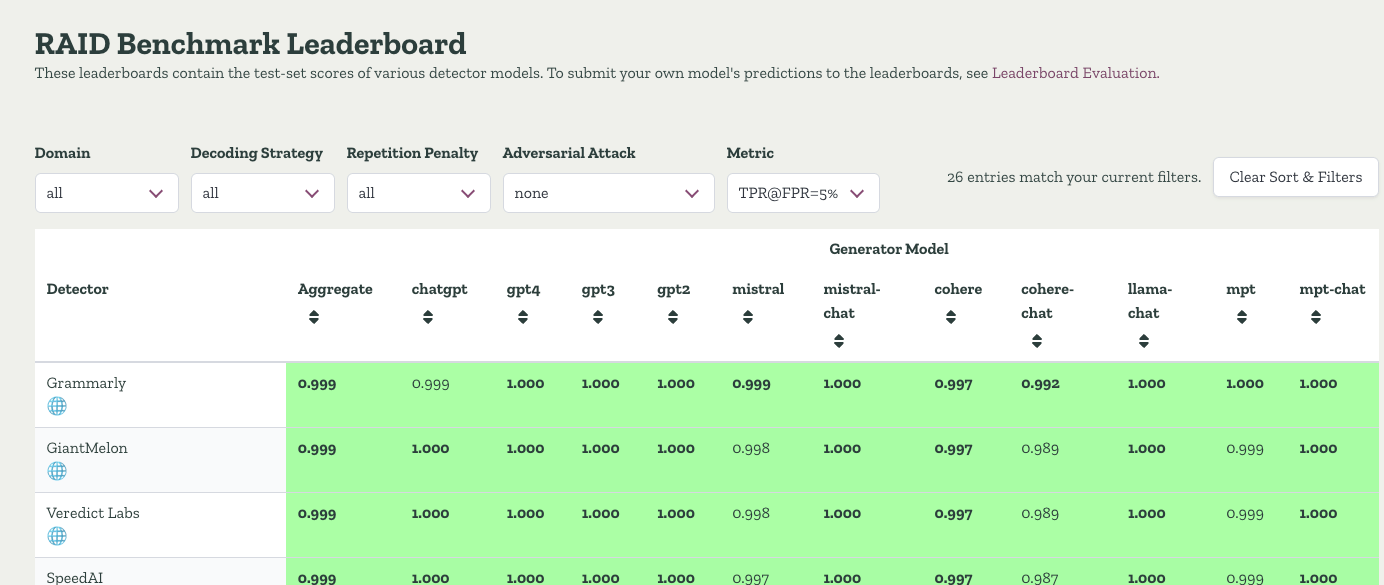
Independent benchmarking offers one of the clearest ways to compare tools. On the RAID leaderboard, Grammarly’s AI Detector ranked #1 for quality, earning a 99% accuracy score in large-scale standardized testing. Results like these indicate strong overall performance across diverse writing styles and AI models.
Best practices for using AI detectors
AI detectors can be useful tools, but they should be used thoughtfully. Using AI detectors wisely helps maintain accuracy, fairness, and ethical decision-making. We recommend the following best practices for working with AI detectors to verify content originality:
- Recognize limitations. AI detectors may produce false positives or negatives. Use them as a guide, not a final verdict.
- Choose tools that are independently evaluated. Look for detectors like Grammarly’s that have been tested under standardized, third-party benchmarks so you can better understand how they perform across large diverse datasets.
- Verify with multiple tools. Different detectors have varying accuracy. Cross-checking results can help reduce misclassification.
- Understand AI writing patterns. AI-generated content often has repetitive phrasing and lacks nuance. Recognizing these signs can help interpret results.
- Consider context, intent, and writing style. A flagged result should prompt further review, not immediate action. Take into account the writer’s typical style, voice, readability, and phrasing. If the text differs significantly from their previous work, AI detection can serve as a check on initial suspicions; however, it should not be the sole determinant.
- Be transparent. Clearly communicate the role AI detection plays in grading or verifying content. Create guidelines for editors and educators so they don’t over-rely on AI detectors when making decisions.
- Use AI detection alongside other originality tools. Since AI detection cannot fully verify content authenticity, combining AI detection with plagiarism checks, citations, and tools like Grammarly Authorship provides a more complete and reliable view of originality.
Future advancements in AI detection accuracy
As AI-generated text continues to evolve, researchers and developers continue to refine detection methods. Future advancements aim to improve reliability, reduce bias, and provide greater transparency. The following advancements aim to make AI detection more effective in the future:
- More robust AI training datasets: Expanding datasets to better reflect diverse writing styles will help mitigate bias and improve detection.
- Better explanations for results: Providing clearer reasoning behind AI-generated content flags can help writers and readers alike know how to move forward with editing work or verifying originality.
- Integration with other originality tools: The best tool to improve AI detection is to combine automated content flagging with AI citations and authorship tracking.
Final thoughts: Are AI detectors accurate?
While AI detectors can provide helpful insights, they are not accurate 100% of the time and should not be the sole measure of originality. AI detection tools work best when used as part of a broader strategy for verifying content and when paired with clear guidelines for responsible AI use. Grammarly offers a holistic approach to content originality that includes plagiarism detection, AI citations, and authorship tracking, which allows writers to provide transparency and uphold integrity in writing. As AI technology continues to evolve, so too will AI detection. Ultimately, responsible AI use, institutional guidance, and informed decision-making remain essential.
AI detection FAQs
Is it possible for an AI detector to be wrong?
Yes, AI detectors can be wrong. AI detectors rely on statistical patterns rather than deep comprehension, meaning they may misclassify text that is overly formal, repetitive, or lacks personal nuance. Writers who speak English as an additional language are particularly vulnerable to misclassification because their writing may differ from the datasets used to train AI detectors. Because of this inherent bias, context, manual review, and additional verification tools are essential when assessing content originality.
Is AI detection accurate?
AI cannot be detected 100% accurately, so you should never rely on the results of an AI detector alone to determine whether AI was used to generate content. AI detectors can identify language patterns that seem robotic or generic, potentially indicating the use of AI, but they cannot definitively conclude whether or not AI was used. These tools should be one part of a holistic approach to evaluating originality. We recommend combining automatic AI detection with manual review and encourage writers to track their writing process with Grammarly Authorship and provide proper attribution when they use AI.
How can I 100% humanize AI text?
There’s no guaranteed way to “100% humanize” AI-generated text with a single edit or tool. AI detectors analyze language patterns, and surface-level changes may not significantly affect how text is classified.
If you use AI as a starting point, the most reliable way to make the final work genuinely your own is to meaningfully revise it—clarifying ideas, restructuring arguments, adding original insight, and ensuring it reflects your understanding and intent. Tools like Grammarly’s AI Humanizer can help refine tone and improve clarity, but thoughtful human input is what ultimately shapes authentic writing.